

I’ve beaten Dragon Quest 7 twice in my life. Once on the original PlayStation, when it was still known as Dragon Warrior, and demanded over a hundred hours of my life. Back when I had all the time in the world to plunge into a game with no remorse whatsoever.
Then, a second time on the 3DS, where I somehow convinced myself that a modest graphical update and some quality-of-life tweaks justified another century-long commitment. I did not have all the time in the world and thus was left deeply remorseful. Both times, I emerged victorious but exhausted – it’s a long game.
So, I felt intimidated by the prospect of Dragon Quest 7 Reimagined. Did I have it in me to complete it again? Reader, I did, and this time, it felt like a sprint, not a marathon.
A World Worth Restoring
More than a fresh lick of paint, Reimagined is a fundamental rethinking of the notoriously bloated classic. The main draw here is the streamlined adventure; still lengthy and substantial (I closed out the main story at around 40 hours, which is a staggering half of my previous ventures), but with modern tweaks that make the experience less agonising.
The introduction is refined considerably, getting you into the action in less than an hour, and entire episodes that really didn’t add much to the experience have been left on the cutting room floor. It feels more appropriate than I’d expected when first learning of such cuts.
The story, like it is in many Dragon Quest games, isn’t some dense epic filled with political intrigue and lore. It’s a romp through a world of disappeared islands, bringing them back one-by-one by changing the past, and unravelling a thin plot regarding the aptly named ‘Demon King’. It’s a serviceable basis for a gameplay cycle, raised by a delightful cast of characters who are given far more personality than their previous incarnations.

Maribel and Kiefer, your earliest companions, benefit enormously from this renewed attention to character detail. The former’s acerbic wit and the latter’s princely charms are capitalised upon wonderfully, making the early hours feel far more grounded in a realistic friendship group rather than relying on classic RPG tropes to move the action forward.
A wonderful aspect of the game to discover is that the run-of-the-mill NPCs, usually mere set dressing, are paid so much more attention in Reimagined. Virtually every townsperson has unique dialogue that reflects current events, the passage of time, and your presence in their stories. It’s a staggering amount of writing, and it makes speaking to everyone feel less like a completionist chore and more like eavesdropping on a living world.
Dragon Quest’s humour has always walked a peculiar tightrope – broad enough to earn a smile, earnest enough to avoid cynicism – and Reimagined continues that tradition. The gags land, the puns are groan-worthy in the best possible way, and the tonal whiplash between tragedy and levity somehow never feels jarring.
Credit, as always, goes to the localisation team, who remain among the best in the business. Accents and dialects are rendered with care in both the writing and the English dub; characters sound like they belong to their regions without tipping into caricature (or, rather, too far into caricature). It’s the kind of work that often goes unnoticed when done well, and it’s done exceptionally well here.
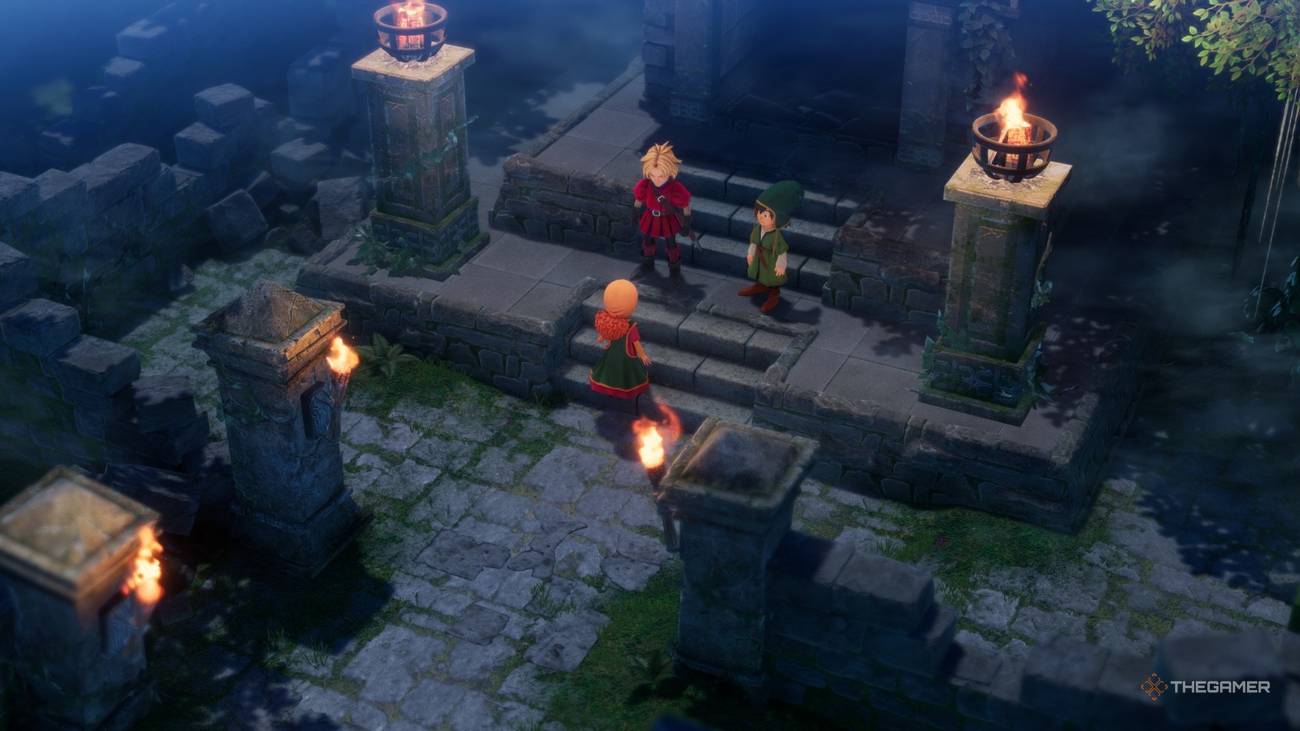
The visual presentation deserves its flowers perhaps over the writing, though. Square Enix’s ‘diorama style’ approach, born from scanning actual handcrafted figurines, gives Reimagined a warmth that screenshots simply cannot convey. Characters have a tactile, almost toylike quality that manages to honour Akira Toriyama’s iconic designs while carving out its own identity.
It’s a far cry from the blocky compression of the 3DS version, managing to evoke the PlayStation version’s sense of scale and wonder. It’s nostalgic without being too on-the-nose, perfect for a gem of a remake such as this.

A Refined Grind
Gameplay is rather ‘painting by numbers’ – you dive into pasts, speak to townspeople to find out what the local problem is, and then you deal with that problem. Then, in the present, you get to see the results of your efforts and reap some rewards, which inevitably include fragments of puzzles to unlock the next areas.
Scenario writers have taken a scalpel to the original’s infamously padded runtime, excising or condensing weaker storylines while preserving the emotional core that made Dragon Quest 7 unique among its peers making it far more satisfying. This is still a darker, more melancholic Dragon Quest than most – a series of tragic vignettes about civilisations lost to time, their stories only uncovered by your party of intrepid young adventurers. The episodic structure remains, but individual episodes no longer overstay their welcome.
Streamlining extends to combat, featuring the now-staple feature of faster battle speeds, a robust auto-battle, and the ability to skip battles with the weakest monsters entirely by striking them in the game world. It begins as a classic system; characters get stronger through grinding, learning new skills tied to their vocations (read: classes, or jobs), but the new Moonlighting system overhauls this.
In previous versions, the vocation system eventually devolved into an exercise in grinding every job to completion, resulting in characters with bloated skill lists and little meaningful differentiation. Reimagined’s approach is elegantly restrictive – skills are now tied to active vocations, forcing actual strategic decisions about what you bring into battle.
The equipment system also surprised me with its depth. Dragon Quest has never been a series where I lingered on the equipment screen – you buy the better sword, you equip the better sword, you move on. Reimagined asks for more consideration than that. Secondary effects on weapons and armour matter: elemental resistances, status immunities, stat trade-offs, and passive abilities that synergise with specific vocations.
It reminded me, pleasantly, of Final Fantasy 6’s approach to gear, where clicking ‘optimise’ was often the wrong choice and the Genji Glove sat in your inventory judging you for ignoring it. Here, there are plenty of pieces of equipment that let you go all-in on tweaky build perfection, which the harder difficulty modes reward plainly.
My largest reservation with this combat overhaul, though, would be that I did not get close to a Game Over a single time during my playthrough. Dragon Quest sticks in my mind as one of the trickier, more demanding series, so this was a little disappointing. I was playing on normal difficulty, sure, but this didn’t feel like a normal Dragon Quest experience.
I also found that the few puzzles in the game weren’t challenging enough to keep my attention. Solutions are handed to you too quickly by overenthusiastic allies, and there’s no real headscratcher that feels joyous to overcome. This was quite the disappointment when comparing the game to the original, which had some nasty beauts when it comes to puzzles. Perhaps the game was streamlined too smoothly in these respects.
Dragon Quest 7 has always been the series’ most ambitious entry – a sprawling anthology of tragedy and hope that attempted things no other Dragon Quest has matched. It was also, frankly, too long. Reimagined solves that problem without sacrificing what made the original special. For series veterans, it’s a chance to revisit a flawed classic in its best possible form. For newcomers, it’s finally a reasonable entry point into one of the franchise’s most rewarding narratives. And, for the first time, I can say I’ve finished DQ7 without needing a week of rest.
The copyright of the images used on this page is jointly owned by SQUARE ENIX CO., LTD. and other co-owners. The unauthorized reproduction and distribution of the images is prohibited.
ⒸARMOR PROJECT/BIRD STUDIO/SQUARE ENIX